Target Ideas
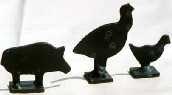


 Charcoal Brickettes!! Yes, the things you BBQ with are great. Assuming you have a powerful enough gun they shatter/fragment well and are cheap and sold by the bag. Try 'em.Little green army men. A classic.
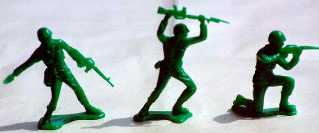 They pop into the air nicely and they are almost indestructible if you can find them again.Plastic bottle caps. Like the ones from a 2 liter bottle. They tend to fragment if hit dead center. Wind chimes. Sounds good.Aluminum cans. Place them on their sides so all you see is a circle. They are light so they tend to move well. Recycling saves the planet.Plastic animals.
Along the same lines as the army men.
They pop into the air nicely and they are almost indestructible if you can find them again.Plastic bottle caps. Like the ones from a 2 liter bottle. They tend to fragment if hit dead center. Wind chimes. Sounds good.Aluminum cans. Place them on their sides so all you see is a circle. They are light so they tend to move well. Recycling saves the planet.Plastic animals.
Along the same lines as the army men. Oreo cookies stand up well and shatter dramatically. For a smaller target with even more drama try grapes! Paint balls explode if you hit them just right. Heavy plastic water bottles often will not puncture, and make a nice sound as you knock them down. You can add duct tape to keep them intact too.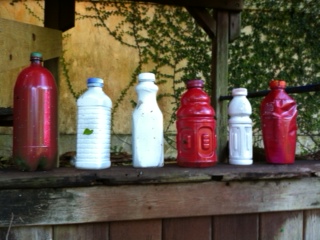
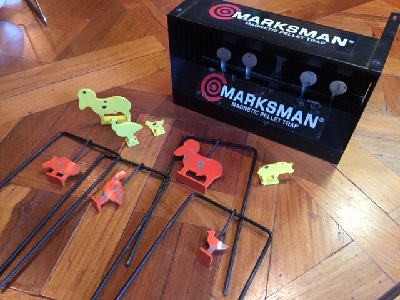
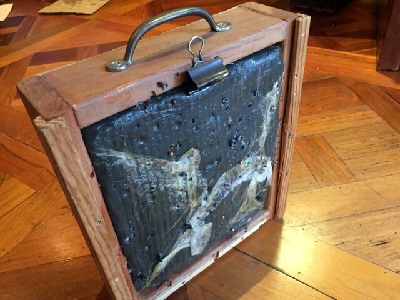
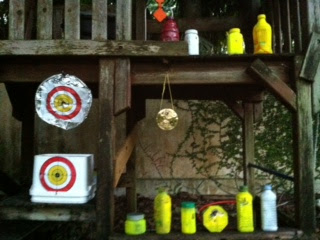 Now here is a target rich environment! Firearm spinners, like the orange one shown here are now made of plastic, so they are lighter, but provide a large target area. If it was that big and metal it would not spin. I like mounting them on wood boards, and that way I can move them around. Also you can see some of the store bought targets I like. They move/knock down and you don't have to get up to reset them! The only down side is that they are kind of tiny, so really for scoped airguns. The boxy thing is a silent pellet trap. It is just some putty form the hardware store in a box. It is great for zeroing a scope or sights.

 Pellet holder: Sucret sore thoat lozenge tins. The lids are hinged and they are the right size. I glue thin foam to the bottom and the lid inside. Anyone have a sore throat? These things taste terrible. This idea from Gary, Mid-MO USA:
I have found several small change purses in the local Wal-Mart which work
very well. These are the kind with the metal tabs which snap past each
other as have been made since the turn of the century or before. The neat
thing is that they are made with two sides. Some have a belt strap but
most need a strap or clip added to hang on a belt. This allows me to
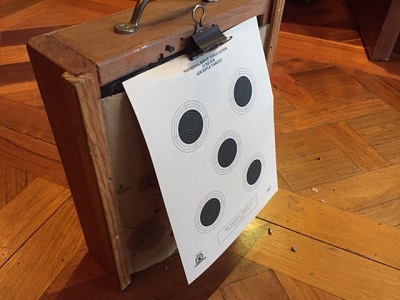
carry two types of pellets in one pouch and they cost less than $3.00. Pellet Holder: A rifle stock ammo sleeve. The ones used to hold .22 bullets sold in many hunting catelogues; it fits on over the stock/ butt end and holds pellets well.Pellet Holder: A tick tack candy box dispenses the pellets nicely and fits in the stock sleeve. See directly above.Pellet Trap: Take a wine box, empty of course, and fill it full of packing popcorn/peanuts which are made of styrafoam. Add a pice of carpet in the back just in case, and tape a paper clip to the front so you can hang paper targets.
The Phillips Pelletholder that fits onto a Talon airtank stock. Go to:
pellect holder.com , or see the links section.
Pellet holder: Sucret sore thoat lozenge tins. The lids are hinged and they are the right size. I glue thin foam to the bottom and the lid inside. Anyone have a sore throat? These things taste terrible. This idea from Gary, Mid-MO USA:
I have found several small change purses in the local Wal-Mart which work
very well. These are the kind with the metal tabs which snap past each
other as have been made since the turn of the century or before. The neat
thing is that they are made with two sides. Some have a belt strap but
most need a strap or clip added to hang on a belt. This allows me to
carry two types of pellets in one pouch and they cost less than $3.00. Pellet Holder: A rifle stock ammo sleeve. The ones used to hold .22 bullets sold in many hunting catelogues; it fits on over the stock/ butt end and holds pellets well.Pellet Holder: A tick tack candy box dispenses the pellets nicely and fits in the stock sleeve. See directly above.Pellet Trap: Take a wine box, empty of course, and fill it full of packing popcorn/peanuts which are made of styrafoam. Add a pice of carpet in the back just in case, and tape a paper clip to the front so you can hang paper targets.
The Phillips Pelletholder that fits onto a Talon airtank stock. Go to:
pellect holder.com , or see the links section.
The first myth I need to dispell is one I always thought of as true: the wind at the target affects the pellet the most since at that point the pellet is moving more slowly. That made uneducated sense, since the wind has more time to push the pellet to the side. So I always looked at the grass near the target to judge the wind. In 'physics reality' it is the wind closest to the barrel that affects the pellet the most. This is because of two reasons: First, any movement to the side early on is magnified farther down range--based purely on geometry. A few degrees here is more space there. Anyone who uses a scope knows this. Second, the pellet is more affected by wind early on, or rather, it is more suspectable as it leaves the barrel for it has not yet stabilized in flight. It has a certain amount of yaw or wobble. Down range it has settled into a stable rotation--that nice spiral that I can never throw with a football--and is less affected by wind.
Next, the weight of the pellet is important, for a more massive projectile is more difficult to persuade sidways. The caliber size is also a factor: larger calibers tend to have more ballistic efficiency.
All of this explains to a degree why the more powerful precharged guns shooting heavier pellets have less wind drift. One more point, the wind at 90 dergees to the path of flight is more of an effect that less or more that 90 degrees. From now on I guess I will have to tie a silly piece of string to the end of my gun, or at least watch the grass just ahead of me.
Magnification is a factor of the number and curvature of lenses, denoted by an "x", e.g. 20x.
Light gathering is a factor of the diameter of the objective and lenses, e.g. 44mm, and this is merely how big the front of the scope and sometimes the tube (1 inch, for example) is to allow more light in to reach your eye. The more you magnify something the more lenses it passes through and the more light is lost. So starting out with more light will solve some of this problem.
I should explain. When the light passes from air to glass or glass to air about 5% is reflected away. Add this up at each surface and you can lose 50% or more! No wonder those targets in the woods seem dark. What to do? You can zoom down the magnification, get a bigger objective to gather more light, or you can add optical coatings!
What are coatings? I am glad you asked. Optical coatings are super-thin layers of chemical compounds that decrease reflection and increase transmission of light. The most common type is a single layer of magnesium floride, which I believe is green. It decreases the amount of reflected light from 5% to about 1.5%. If appllied ot all the air-to-glass surfaces in a scope--I guess 10 or more--this can increase light transmission to better than 80%. Hey from 50 to 80%, now we're getting somewhere. Multipule layers of different materials can improve preformance even more. (Read more cost.) The best multi-coatings reduce the reflection from a single surface to .25%, allowing 95% transmission of light. Now that's not bad. Depending on the coating, surfaces may appear green, red, yellow, etc. The real benefit is image contrast. Much of the light reflected from poorly coated surfaces inside the scoped scatters randomly, like a trapped BB bouncing around, and creates a hazzy or foggy image.
The terminology is a follows. If the ad says coated optics at least one lense surface is coated with a single layer. Usually the outside of the objective and eyepiece. Fully coated means that all lens surfaces are single coated. Multi-coated means one surface has multiple layers, and others are likely single coated, but may not be coated at all. Fully multi-coated should mean all air to glass surfaces are coated and probably are all multiple-layer coatings. If it doesn't say it is one of these there is no guarantee it is. It seems that even though some manufactures don't state all of the above but just charge more and have a better reputation, like leuopold, it's that they gain a better sight picture through coatings. It's America and you get what you pay for.